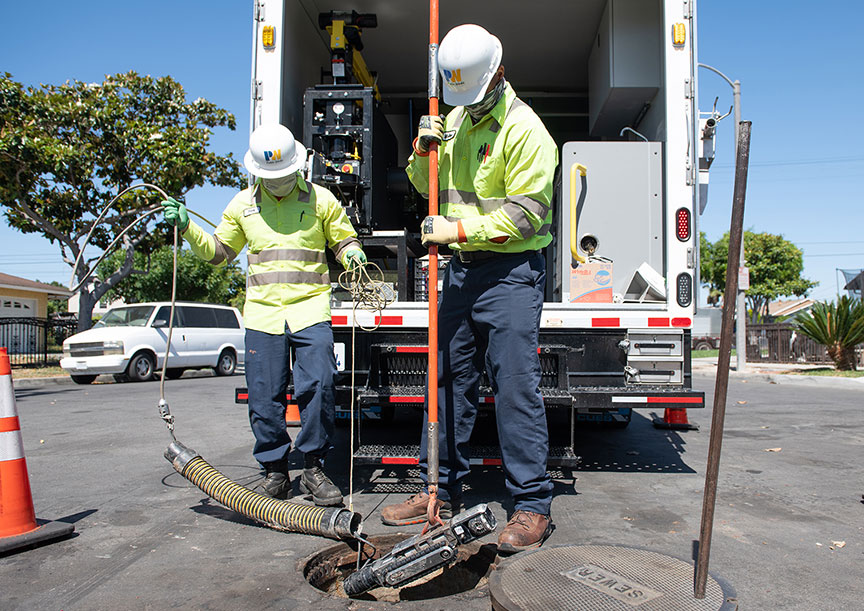
Photo by Joe Zumbo, Central San
The State Water Resources Control Board (State Water Board) has issued a Public Notice announcing the release of the informal staff draft statewide Sanitary Sewer System General Order and two upcoming public workshops. State Water Board staff will be conducting two virtual public workshops to summarize the informal staff draft Order on the following dates:
 Both public workshops will be providing the same information. The discussion among workshop participants may vary.
The public notice, informal staff draft Statewide Sanitary Sewer System General Order and the instructions to participate in the public workshops are available on the Sanitary Sewer Overflow Reduction Program website.
Staff is providing the informal staff draft Order to interested parties to receive informal feedback prior to finalizing the draft Order for a forthcoming official public comment period. Staff will listen to informal oral feedback provided during the above workshops, and if necessary, will follow up with focused interested-party meetings to assure clear communication of high-level concerns regarding the informal staff draft Order.
For each scheduled workshop, participants are provided the following two participation options:
Option 1: Participate in the Zoom meeting and be able to ask questions and provide feedback to State Water Board staff during the workshop, or
Option 2: View and listen to the public workshop through the CalEPA webcast. This option will not allow participants to ask questions or provide feedback to State Water Board staff during the workshop.
Please complete and submit the corresponding registration form by midnight of the day prior to the scheduled workshop: On the morning of the workshop, State Water Board staff will email the Zoom meeting link to people who registered in advance.
Please view the workshop through the CalEPA Webcast web page at https://video.calepa.ca.gov.
Workshop participation interest may exceed the Zoom meeting capacity. If you are not planning to ask questions or provide feedback to Water Board staff during the workshop, please participate through the CalEPA webcast, allowing space in the Zoom meeting for other participants.
If you are planning to attend the Zoom meeting and need interpretation assistance, please email [email protected] or call (916) 341-5455 with an interpretation request. Please specify the workshop date and the specific language.
If you have additional questions about these instructions, please email [email protected].
 My Profile